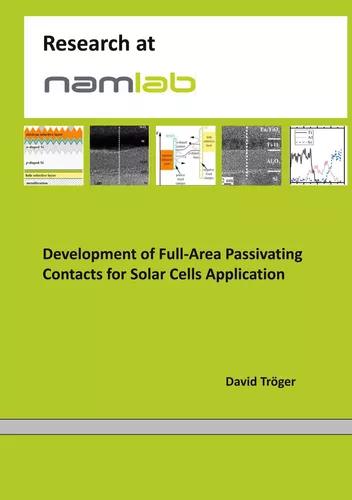
The state-of-the-art PERC solar cell is passivated with Al2O3 or H:SiNx.
these dielectrics must be opened locally to extract the generated photo current
by a direct metal-semiconductor contact. These contacts induce a high
density of interface states, known for increasing the surface recombination
velocity and decreasing the solar cell efficiency. To circumvent the direct
metal-semiconductor contact, this thesis investigates a cell concept, which
based on a full-area passivation by Al2O3 or H:SiNx without local openings.
On the one hand, such a passivating and non-conductive dielectric has to
be thin enough to extract the photo current with lowest possible ohmic
losses. On the other hand, the passivation has to suppress the charge carrier
recombination at the Si/dielectric interface as much as possible. With
respect to these criteria, Al2O3 and H:SiNx layers were deposited with optimized
process parameters. In conjunction with these passivation layers,
also a transparent conductive oxide was developed, which enables a certain
carrier selectivity to extract just one type of charge carriers, i.e. electrons or
holes. This study focuses on the development of TiOx as electron-selective
contact and NiO or WOx as contact. The deposited contacts are examined
with respect to their structural, electrical and optical properties. The findings
are used to form an optimized full-area carrier selective contact. Both,
the thin passivation layers and the carrier selective contact, are combined
to form a full-area passivating contact for p-doped as well as for n-doped
Si. The developed full-area contacts exhibit the potential to replace the
typical metal-semiconductor contacts in state-of-the-art PERC solar cells.
Eigene Bewertung schreiben








Es sind momentan noch keine Pressestimmen vorhanden.