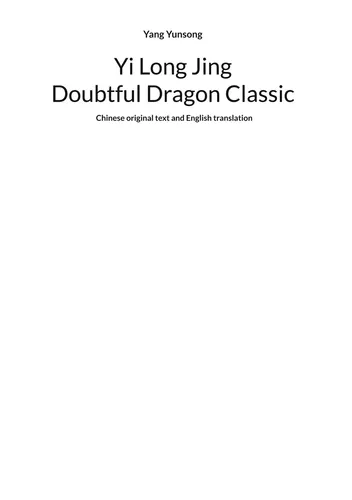
The Yi Long Jing, the Doubtful Dragon Classic, is a fundamental work of the Form School of Feng Shui. Written in the late Tang Dynasty about 1100 years ago, it describes in detail how to recognise the Dragon, and the general position of the nest/acupoint. This book comes with the original Chinese line text and a most literal English translation.
Yang Yunsong (also known as Yang Jiupin, "Yang Who Saves the Poor") was a prominent geomancer and scholar of the late Tang Dynasty (618-907 CE), active primarily during the 9th century. Yang Yunsong was a renowned Feng Shui Master
Historical records, such as those in Qing Nang Jing commentaries and later geomantic texts, suggest he served as a court geomancer, possibly holding a minor official position in the Tang imperial court, advising on auspicious locations for buildings and tombs to ensure harmony and prosperity. His nickname "Jiupin" reflects his reputation for aiding the poor through geomantic consultations, indicating he worked beyond elite circles.
Yang Yunsong is credited with authoring or contributing to foundational Feng Shui texts, including the Qing Nang Jing, Qing Nang Ao Yu, and Tian Yu Jing, though exact authorship is debated due to the Tang-era practice of attributing works to revered figures. These texts systematized geomantic principles, focusing on topographic features like Dragon and Tiger ridges, nest locations, and spatial arrangements aligned with cosmological patterns. His work emphasized practical applications of Feng Shui, making it accessible for both imperial and common use. He is also noted for training disciples, spreading geomantic knowledge across southern China, particularly in Jiangxi and Fujian.
Modern Feng Shui practitioners still reference his principles, and his legacy endures in Chinese cultural heritage.
Walter Ziems (Hrsg.)
Walter Ziems is a Feng Shui practitioner focusing on the Form School. You can find him at: www.othala.me







Es sind momentan noch keine Pressestimmen vorhanden.