As power electronic devices become the backbone of modern energy systems, their complex interactions increasingly shape the stability and dynamics of the grid. Traditional analysis methods can no longer keep pace with the rapid rise of inverter-based technologies. This thesis explores advanced extensions to widely used impedance-based stability analysis, offering new tools to understand and manage the behavior of power-electronic-dominated systems.
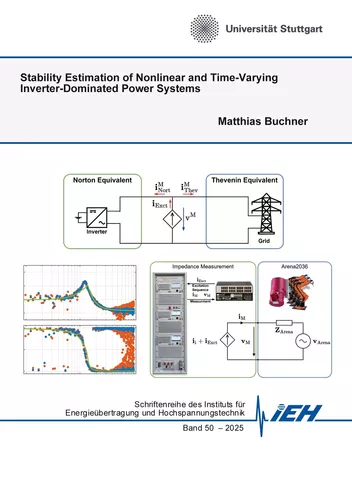
Combining analytical modeling with innovative experimental techniques, it introduces a method to assess the stability of nonlinear inverters under real, time-varying grid conditions, validated through detailed time-domain simulations. A novel compensation approach for impedance measurements demonstrates significant improvements in accuracy even in grids affected by strong harmonic distortion.
Applying these methods to real-world scenarios, the work evaluates the stability of electric-vehicle charging at grid connection points with a high penetration of power electronics and provides a practical framework for estimating how many EVs can be safely integrated.
Matthias Buchner, M.Sc., is a power-systems engineer with a strong background in inverter-based energy systems and grid stability. During his work at the Institute of Energy Transmission and High-Voltage Technology (IEH) at the University of Stuttgart, he contributed to research on the behaviour of power-electronic devices, microgrids, and modern stability analysis methods.
At IEH he helped develop laboratory and simulation approaches to study grid-connected and islanded operation of inverter-dominated systems. A central part of his work focused on impedance-based stability analysis and on improving grid-impedance measurements in networks with high harmonic distortion.
He authored several scientific publications on impedance measurement, microgrid transitions, and inverter modelling. His research supports a better understanding of how power electronics interact within modern grids and provides important foundations for the reliable operation of future energy systems.









Es sind momentan noch keine Pressestimmen vorhanden.